

Memory
The memory service provides semantic memory stores for AI agents — enabling them to remember context across conversations using vector-based storage and retrieval. Operators manage stores under Data → Agent Memory.
Agent Memory
A memory store is the unit that binds an embedding model to a vector index — it's where individual memory items live, scoped to a project. The list view shows total stores, total memories across all stores, and how many stores are currently active.
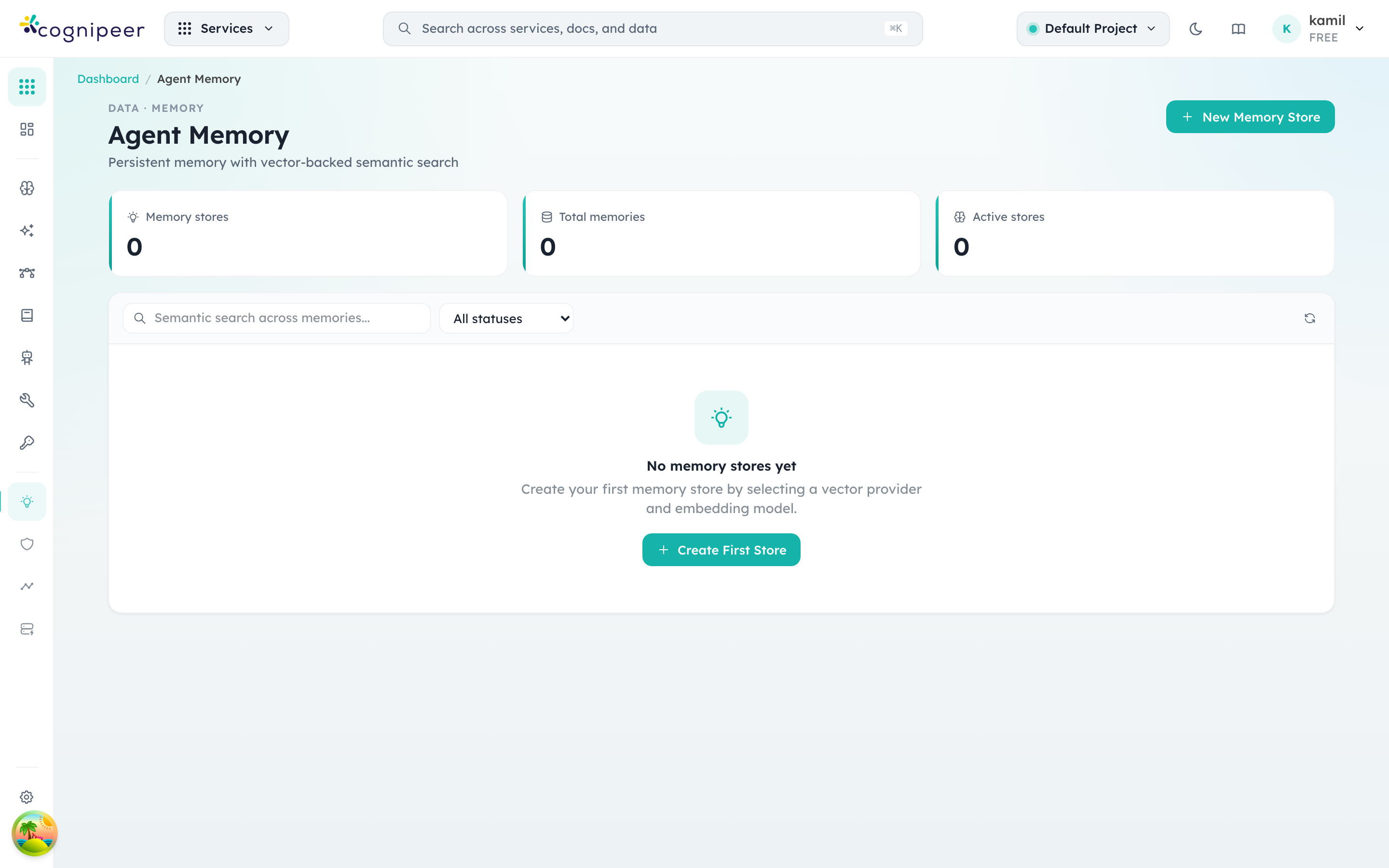
Creating the first store requires two prerequisites: a vector provider configured in Knowledge Index and an embedding model deployed in Model Hub. The Create First Store flow walks you through both — it'll halt and point to the missing piece if either isn't ready.
Once a store exists, every memory item carries content, free-form tags, an importance score, and an optional scope. Agents read from the store via the search() and recall() APIs documented below — recall() is the chat-optimised variant that respects a max-tokens budget.
Concepts
| Concept | Description |
|---|---|
| Memory Store | Configuration container linking an embedding model and vector index |
| Memory Item | A single memory entry with content, tags, scope, and importance |
| Search | Semantic similarity search across stored memories |
| Recall | Chat-optimized retrieval with token limit awareness |
Service Functions
| Function | Description |
|---|---|
createMemoryStore() | Create store with vector index + embedding model |
listMemoryStores() | List stores for project |
getMemoryStore() | Get store by key |
updateMemoryStore() | Update config/status |
deleteMemoryStore() | Delete store + vector index |
addMemory() | Add single item (embed → store) |
addMemoryBatch() | Batch add items |
listMemoryItems() | List items in store |
getMemoryItem() | Get single item |
updateMemoryItem() | Update content (re-embed if changed) |
deleteMemoryItem() | Delete single item |
deleteMemoryItemsBulk() | Bulk delete |
searchMemories() | Semantic search |
recallForChat() | Chat-optimized recall with token limit |
Create Store Request
{
  "name": "Agent Working Memory",
  "vectorProviderKey": "pinecone-prod",
  "embeddingModelKey": "text-embedding-ada-002"
}The store key is generated automatically, and creating a store provisions the backing vector index.
Client API
Create Memory Store
POST /api/client/v1/memory/stores
Authorization: Bearer <token>Add Memory
POST /api/client/v1/memory/stores/:storeKey/memories
Authorization: Bearer <token>{
"content": "User prefers dark mode and concise responses",
"scope": "user",
"tags": ["preferences", "ui"],
"importance": 0.8,
"metadata": { "userId": "user-123" }
}Search Memories
POST /api/client/v1/memory/stores/:storeKey/search
Authorization: Bearer <token>{
"query": "What are the user's UI preferences?",
"topK": 5,
"scope": "user",
"scopeId": "user-123",
"tags": ["preferences"],
"minScore": 0.7
}Response:
{
  "memories": [
    {
      "id": "mem_123",
      "content": "User prefers dark mode and concise responses",
      "score": 0.94,
      "scope": "user",
      "scopeId": "user-123",
      "tags": ["preferences", "ui"],
      "metadata": { "userId": "user-123" },
      "importance": 0.8
    }
  ],
  "query": "What are the user's UI preferences?",
  "storeKey": "mem-agent-working-memory"
}Recall for Chat
POST /api/client/v1/memory/stores/:storeKey/recall
Authorization: Bearer <token>{
"query": "What does this user like?",
"scope": "user",
"scopeId": "user-123",
"topK": 5,
"maxTokens": 500
}The recall function is optimized for chat contexts. It returns a compact context string together with the matched memories, trimmed to fit the requested token budget.
Memory Properties
| Field | Description |
|---|---|
content | The memory text |
scope | Categorization (e.g., user, session, global) |
source | Origin identifier |
tags | Array of string tags for filtering |
importance | Float 0-1, influences ranking |
metadata | Arbitrary key-value pairs |
Pipeline
Adding a memory:
Content → Embed (via inference service) → Vector Upsert → Store metadataSearching memories:
Query → Embed → Vector Search → Rank by score + importance → ReturnDependencies
- Inference Service — For generating embeddings
- Vector Service — For storing and querying vectors