

Vector Stores
The vector store service provides multi-provider vector database management with index CRUD, vector upsert/query/delete operations, and runtime pooling. Operators manage it through Data → Knowledge Index.
Knowledge Index
The list view groups indices by their vector provider. Counters at the top show how many indices are deployed, how many providers are wired up, and how many providers are currently failing health checks.
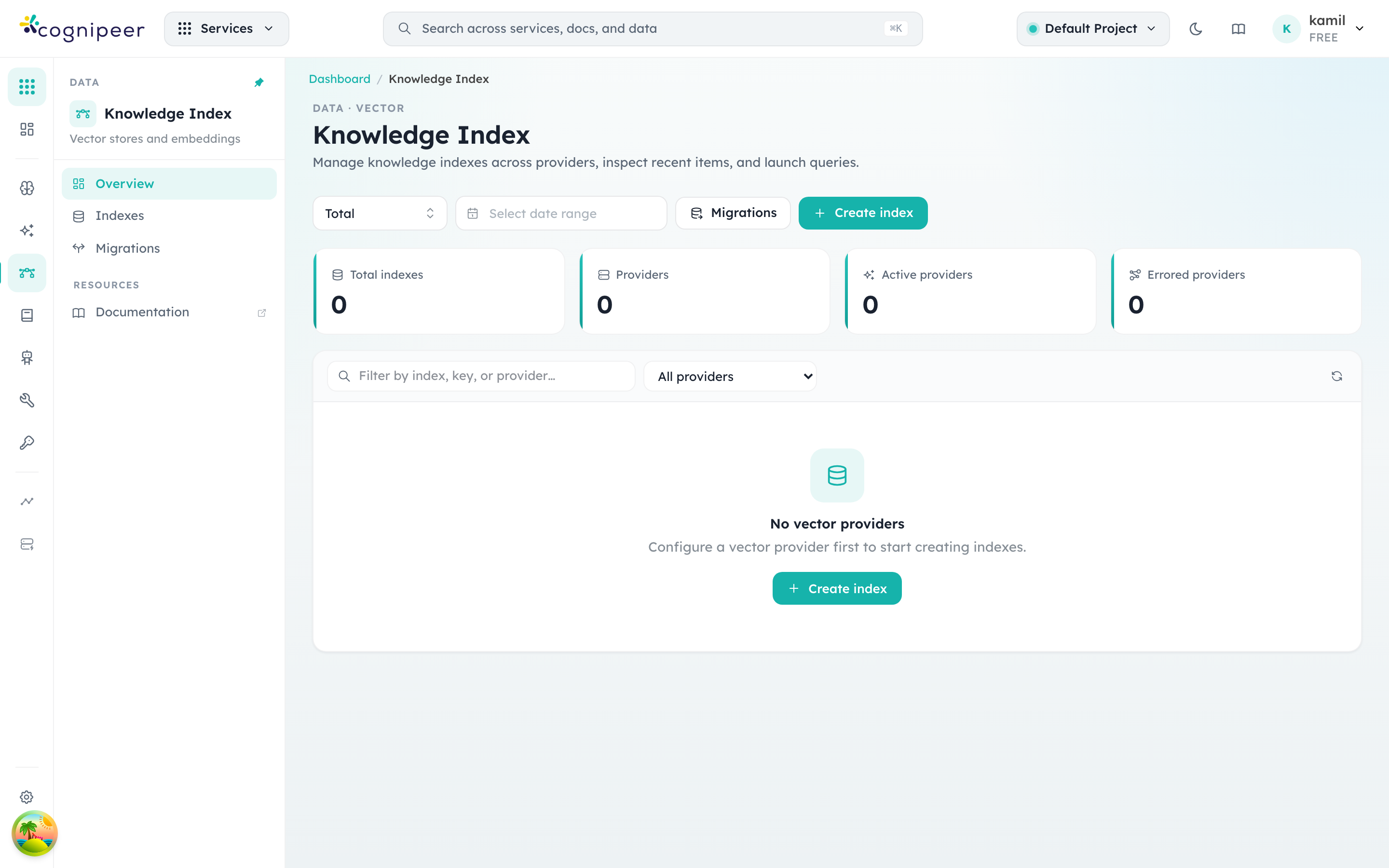
A fresh tenant lands on the empty state — the Create index action only enables once at least one vector-domain provider has been registered. The Indexes and Migrations entries in the left sidebar give you flat list views; Migrations is where you reshape indices when you change embedding dimensions or rename keys.
Supported Providers
Providers are registered through the contract system:
| Provider | ID | Description |
|---|---|---|
| SQLite Vector | sqlite-vector | Local brute-force similarity search using SQLite. No external dependencies. |
| Postgres | postgres | Postgres/pgvector-backed vector storage |
| Azure AI Search | azure-ai-search | Managed vector search on Azure AI Search |
| AWS S3 Vectors | aws-s3-vectors | S3-based vector storage |
Additional providers can be added via the provider contract mechanism.
SQLite Vector Provider
The built-in SQLite vector provider stores embeddings locally with brute-force cosine/dot/euclidean similarity search. Ideal for development, small-scale deployments, or environments without external vector database access.
# No extra configuration needed — just create a provider via API or UI
# with driver: "sqlite-vector" and settings.basePath: "./data/vectors"Capabilities:
- Cosine, dot-product, and euclidean similarity metrics
- Upsert with conflict resolution
- Batch vector operations within transactions
- Per-tenant, per-provider isolated SQLite files
Limitations:
- Brute-force search (scans all vectors per query) — suitable for up to ~100K vectors per index
- No metadata filtering (planned)
Service Layer
The vector service (src/lib/services/vector/vectorService.ts) provides tenant-scoped operations:
| Function | Description |
|---|---|
listVectorDrivers() | List available vector provider drivers |
listVectorProviders() | List tenant's configured providers |
createVectorProvider() | Create a provider configuration |
createVectorIndex() | Create an index with unique key |
listVectorIndexes() | List indexes for a provider |
getVectorIndex() | Get index with metadata |
updateVectorIndex() | Update index name/metadata |
deleteVectorIndex() | Delete index and remote resources |
upsertVectors() | Upsert vectors to an index |
deleteVectors() | Delete vectors by IDs |
queryVectorIndex() | Similarity search |
API Endpoints
List Providers
GET /api/client/v1/vector/providers
Authorization: Bearer <token>Optional query parameters: status, driver
Create Provider
POST /api/client/v1/vector/providers
Authorization: Bearer <token>{
"driver": "postgres",
"name": "Production Vectors",
"credentials": { "connectionString": "postgres://..." },
"settings": { "schema": "public" }
}Create Index
POST /api/client/v1/vector/providers/:providerKey/indexes
Authorization: Bearer <token>{
"name": "Product Embeddings",
"dimension": 1536,
"metric": "cosine"
}Index names are deduplicated — if an index with the same normalized name exists, it is reused.
Query Vectors
POST /api/client/v1/vector/providers/:providerKey/indexes/:externalId/query{
"vector": [0.1, 0.2, ...],
"topK": 10,
"filter": { "category": "electronics" }
}Key Generation
Each index gets a unique key derived from its name:
"Product Embeddings" → "product-embeddings"
"Product Embeddings" (duplicate) → "product-embeddings-1"The generateUniqueIndexKey() helper ensures uniqueness within a tenant.
Runtime Context
Building a runtime from stored configuration:
const { runtime, index } = await buildRuntimeContext(tenantDbName, providerKey);

// The runtime is cached in runtimePool
// Credentials are decrypted and validated
// Provider status is checked (must be 'active')Vector Provider Runtime Interface
interface VectorProviderRuntime {
  createIndex(params: CreateIndexParams): Promise<IndexInfo>;
  listIndexes(): Promise<IndexInfo[]>;
  describeIndex(name: string): Promise<IndexInfo>;
  deleteIndex(name: string): Promise<void>;
  upsertVectors(index: string, vectors: VectorRecord[]): Promise<void>;
  queryVectors(index: string, vector: number[], options: QueryOptions): Promise<QueryResult[]>;
  deleteVectors(index: string, ids: string[]): Promise<void>;
}Validation
- Vector dimension is validated before upsert operations
- Provider type and status are checked before any runtime operation
- Credentials are validated during runtime construction
Metadata Filtering
Queries can narrow candidates by chunk metadata using one provider-neutral filter language. The control plane parses and validates the filter once, then each driver translates it into its store's native syntax and pushes it down.
Filters are never applied after the query. A driver that cannot express an operator rejects the request with a 400 naming what is unsupported, instead of returning results that quietly ignore the filter. That way topK always means "topK matching documents".
Filter language
{ "source": "crawler" }                       // shorthand for $eq
{ "depth": { "$lte": 2 }, "lang": "tr" }      // several fields are ANDed
{ "lang": { "$in": ["tr", "en"] } }
{ "draft": { "$exists": false } }
{ "$or": [{ "source": "crawler" }, { "$not": { "depth": { "$gt": 5 } } }] }
{ "$raw": { "term": { "metadata.source": "crawler" } } } // provider-native escape hatchField operators: $eq, $ne, $gt, $gte, $lt, $lte, $in, $nin, $exists. Composition: $and, $or, $not. $raw replaces the entire filter and cannot be combined with other keys.
Provider support
| Driver | Push-down | Notes |
|---|---|---|
elasticsearch, elasticsearch-cloud, elasticsearch-self-hosted | full | Exact matches target the .keyword sub-field. |
postgres | full | Parameterised jsonb predicates in the same SELECT. |
sqlite-vector | full | Evaluated during the scan, before top-K selection. |
mongodb-community-vector | full | Applied as part of the scan query. |
milvus, milvus-cloud, milvus-local | full | Requires a collection created with the JSON metadata column (see below). |
mongodb (Atlas) | no $exists | Filtered paths must be declared in the Atlas vector index. |
aws-s3-vectors, system-default | no $not | Metadata keys must be filterable in the index. |
chroma, chroma-cloud, chroma-local | no $not, no $exists | Chroma where has no equivalent. |
azure-ai-search | equality family only | $eq, $ne, $in, $nin, $exists; range operators are not expressible (see below). |
orama | none | Metadata is stored as an opaque JSON string; filtered queries are rejected. |
Every driver except orama also accepts $raw.
Index schema requirements
Two stores need an index created by a current version of the console before filters can be pushed down; older ones keep serving unfiltered queries and reject filtered ones with an actionable error:
- Azure AI Search cannot filter inside the metadata JSON blob, so indexes now carry
metadata_kv(flattenedkey=valueentries) andmetadata_keysalongside it. That covers equality and set membership; range comparisons over a string collection are not expressible, so$gt/$gte/$lt/$lteare rejected. - Milvus can only filter a metadata column typed as JSON. Collections created earlier store
metadata_jsonasVarChar.
To enable filtering on an existing index in either store, recreate the index and reingest its documents.
Knowledge Engine
Knowledge Engine modules add two settings on top of the same language:
defaultFilter— ANDed into every query against the module, so several sources can share one vector index while each module retrieves only its own slice.filterableFields— the metadata keys callers may filter on. When set, a query touching any other key is rejected, and the list is advertised to agents and MCP clients so they know what is filterable.
Documents ingested by the crawler carry source, sourceUrl, crawlerKey, jobId, depth, and title, which makes those the natural filterableFields for a crawled knowledge base.
Query Analytics
Every call to queryVectorIndex writes a row to vector_query_logs — index key, provider key, topK, match count, latency, the mean similarity score, and whether a metadata filter was applied, plus the caller attribution (userId/apiTokenId/actorType) resolved from the request context.
The write is best-effort and happens after the search returns: a logging failure is warned about and swallowed, never surfaced as a failed query.
These rows are what the index detail page's analytics panel aggregates (daily query volume, latency, average score, filtered-query share, and the topK distribution). The aggregation runs through the database abstraction (aggregateVectorQueryStats), so the panel works on both MongoDB and SQLite tenants; the day series is zero-filled over the requested window and scoped to the index key resolved within the active project.
Queries also feed the usage rollup as the vector service, keyed by index key, with the match count as a unit and failed searches counted as errors — so vector retrieval shows up in usage and spend views alongside models, Knowledge Engine, and reranker traffic. Query embeddings stay billed through the models service; no tokens are attributed here.